On Animism in Modernity

As a folk witch, I spend a lot of time thinking about previous ages and the beliefs shared by those people. But I also live in modern times; I’m alive here and now, not somewhere else. Sometimes, the ideas and cosmologies inherent in the old lore feel almost incompatible with who we are as modern humans living on the edge of capitalism’s collapse. But it simply isn’t so. In fact, it’s possible that this age needs animist spirituality more than ever.
I’m not interested in putting forth a rigid definition of animist spiritual practice. I’m not interested in deciding who can or cannot call themselves an animist. For one thing, it’s just a boring question. It also assumes a singular definition of lived animism rather than a plurality of practices. I’m more interested in the diversity that already exists among different expressions of animism, even if this challenges the concept of animism itself as a cohesive paradigm. Concepts and ideas aren’t that important, after all. Animism is simply the best term we have for these practices, but we must accept in advance that the term itself is flawed, imperfect from its very beginnings.

Let’s just say it, then: originally, animism was a word made up by white people (specifically, 1800s scholar Edward Tylor) to describe indigenous spiritualities that often (but not always) predate the worship of deities. It is usually applied to the belief in non-human spirits, to the belief in a complex spiritual world governing the forces of nature, entities dwelling within trees, hills, storms, creeks. The idea of spirits at work within flora, fauna, and land features is indeed ancient, and we now know that these beliefs are not a novelty among Siberian shamans, but were once widely held among ancient peoples of virtually every known culture. Today, animism is a term used in modern anthropology to describe a vast and diverse group of spiritual practices thought to be older than organized religion. The interesting pivot here comes from within witchcraft scholarship, specifically in the works of Emma Wilby, Carlo Ginzburg, and their contemporaries, for as this group began to unpack the history of witch lore and folk-magical practice in western Europe, they discovered that old forms of European folk magic actually preserved animist elements that were similar to the practices of shamans and seers in other parts of the world. The term animist, which originally smacked of ethnocentrism, was found to apply equally to the spiritual roots of colonizing cultures, and the fear and hatred of those roots gave rise, in part, to the fear of witches.

In reality, there has always been a disconnection between academic discourse on animism and the lived realities of people who fit within this umbrella. This concept was, after all, defined and pioneered by people who looked down on those who held such beliefs. Modern animism might, in fact, be the first instance of people actively self-identifying with the term. For those of us who chose to identify this way in modern times, it can mean many things. Many of us observe ancestral folk-magical traditions that involve spirit interaction and otherworldly travel. Many of us identify as witches, warlocks, herb doctors, cunning folk, or sorcerers. For myself, I look to the charming traditions of my Scottish and Appalachian ancestors, which preserve the means of calling to plant spirits, warding baneful entities, and entreating fortune and favor from the invisible world of spirits, including the dead.

One of the things I tried to accomplish in A Broom at Midnight was to shine light on the connection between animist views of the otherworld and the flight to the witches’ sabbat, for these otherworldly journeys are iterations of the same spiritual phenomena, as vibrant today as they were hundreds of years ago. Like the shaman’s journey, the witch’s departure into the world of spirits is not ornate, but simple; not elaborately choreographed, but improvisational; not imaginary or merely “visualized,” but vividly psychonautic and ecstatic. When we, as witches, contextualize this ecstatic praxis as a part of the greater tapestry of animist spirituality among human beings everywhere, we are better able to understand ourselves, but we are also actively dissolving the racist framework that would cast some spiritualities as “civilized” and others as “primitive.” We witness for ourselves that animist spirituality is every bit as complex, sophisticated, and ornate as theological traditions. We also begin to recognize that animism does not exist in a vacuum, but blends and syncretizes with other forms of faith. Even Frazer in The Golden Bough recognized that many cultures experienced animism and theism at the same time (though he mistakenly viewed theism as a more “evolved” spirituality).

Often, the choice to identify as a modern animist is simply an acknowledgement that our spirituality is informed by these types of beliefs, even in broad strokes, that regular interaction with spirits is a part of who we already are, inseparable from the spiritual cultures in which we are rooted. I like this meaning best, for it is the roomiest and probably applies to most practitioners under this umbrella. Perhaps we only interact with a handful of specific spirits in our regular practice. Perhaps we live in an urban area and keep potted plants rather than strolling a deep forest. Perhaps our physical condition prevents us from taking long, wandering hikes to connect with land spirits. These activities are merely examples of practice, not edicts to be followed. In whatever ways we are able, in whatever way we can, what seems to unite most modern animist practice is the recognition of selfhood in the non-human other; the belief that a forest, a lake, a tree, or a frog is possessed of a spirit and a selfhood that exists for its own purposes and operates based on its own rules. We share a world with these beings, but they can never belong to us. They are not ours. On the contrary, if we act without cunning, we are often at their mercy, not the other way around.

This approach to modern magical practice comes with certain concrete benefits. When forging a relationship with a spirit governing a particular plant, we will usually spend a great deal of time observing it, watching how it grows and withers, how it reacts to its environment. We realize how unique each species is, and in this realization, we arrive at our own doctrine of signatures. Suddenly, the old “correspondences,” though certainly viable in a broad sense, become less useful to us personally. We can discern for ourselves the ways in which a particular plant is martial, venereal, or saturnine. We’ve simply no need for a book to tell us how to read a plant or an animal anymore. We have eyes. Similarly, we are less bound by ceremonial traditions of spirit evocation because we learn to interact with spirits using simpler, more direct methods, forging personal relationships with very real benefits in the form of revealed charms, sigils, and lessons that guide us in the progress of our craft. These practices do not preclude us from participating in modernity, but they provide a grounding center, a moment of solace that restores and realigns us. We are reminded that human beings are not the center of the world or the pinnacle of evolution, but are just another form of living thing, no greater and no less.

The extension of this same grace to what we might call “dark” spirits is perhaps less commonly held among modern animists, though I believe this is changing. The church’s vast colonizing influence in Celtic countries transformed the belief in ancestor spirits, recasting the honored dead as elves, fairies, and demons. These beliefs were carried over by immigrants to the new world, and even today, I regularly come across witches who perform routine exorcisms and cleansings to threaten, berate, and harm dark spirits without even trying to understand them first. Though malevolent spirits are real, they are rarer than one might think simply because humans aren’t all that interesting. We are more alike than we are unique, and though it is human nature to imagine ourselves special and intriguing to the spirit world, this is a narcissistic overestimation of our importance. The unpretty truth is that we are usually regarded by spirits (if they regard us at all) as mere pests or trespassers.

If we acknowledge that the spirit world is as diverse and interwoven as the ecological world, we must also be ready to admit our limited perspective within it. In the absence of our demons and our angels, we witness the difficult, more complicated truth: a spirit world of natural predation, of usually faultless harm, of carnivorous, parasitic, or toxic entities that may often be unaware of their influence or even of our existence. We begin to understand that we, as human beings, are not actually very important. Usually, we’re just in the way, much like standing in the path of a flood or walking too close to a hive of bees. A modern animist’s approach to warding is usually not to destroy, but to understand. Our ghosts and phantoms, our hauntings and demons and shadows are not enemies, but kin, and it is wiser to establish clear boundaries and agreements than it is to declare war on a kingdom that outnumbers us.

The most difficult question, and the one I do not have the ability or the desire to answer here, is how the animist negotiates the relationship with modernity, with capitalism, with personal responsibility in the face of ecological collapse. Ideally, we take ownership of the choices we have and try to respect the other beings in our world as best we can. But for the past fifty years, corporations responsible for 99% of environmental damage have been waging expensive disinformation campaigns in order to convince us that it is the “masses” who are responsible for climate change. Billionaires squeeze profits from the working class like a spider sucks its prey. Poor and disempowered individuals are blamed for all manner of disasters. But who has built the web? Much of our disconnection to the world of flora and fauna is not a conscious choice, but a choice made for us by corporate powers and the governments that bow to their interests.

On the other hand, the romanticization of the country life, so ubiquitous in aesthetics like “cottage-core” and “witch-core,” portrays only the consumption and taming of nature, not the realities of planting and harvesting, not the sweat, the ugliness, the bug bites, the scratches and sprains that come with actually living alongside nature. But who am I to judge? Perhaps even this representation is an awkward step forward. I believe that the massive political shift we need in order to prioritize the other beings in this world will come not through preaching or scolding, but through the act of personal witness, through individuals coming to love and appreciate the wild around them, and the more we can do to facilitate this change, the better.
On Self and Image

Recently, I’ve been thinking a great deal about how we present ourselves as witches, and especially of the images we curate in online spaces. A new witch poring over social media might deduce that we are all at our altars from dusk to dawn, fumigating animal skulls and grinding herbs until our elbows creak, our candles a constant and unending fire that we tend to day and night. If the thought of this exhausts you as much as it does me, let’s consider for a moment how overwhelmed a budding young witch must feel.

They probably wonder if their efforts can ever be enough when tasked with this unending labor, if they can manage the gargantuan investment of time it would take to dedicate themselves in what they believe to be the necessary degree, if they are comfortable changing their appearance and behavior in so many ways in order to fit in with the occult glitterati they see performing before their eyes. How utterly overwhelming and how misleading these images are when approached without context. And how embarrassing for us when our spiritual practices are mistakenly perceived as a mere trend–or worse–a “lifestyle” (whatever that odd and oft-abused word really means).

Nor am I innocent in all of this mess. As a person who values privacy, the parts of my life I choose to share publicly are limited and curated around my craft, and so many moments that matter to me are not recorded or projected in online spaces. My partner’s long and difficult cancer treatment isn’t there. Those overwhelming weeks spent in hospitals aren’t there. The recent loss of our beloved cat isn’t there. My struggles with anxiety and self-criticism aren’t there. The pile of unfinished projects, the nourishing meals shared with loved ones, the laughter and the glasses of wine, those aren’t there. One might easily mistake us for witches and nothing else, but we are in fact whole people with whole lives. New witches should try to remember that the public images of ourselves that we choose to share are just that: images. Chosen and constructed. A partial picture. They cannot capture whole realities.

But the witch’s mundane moments are real, and they are important. Most of the time, I am not conjuring spirits, analyzing cartomantic spreads, and binding smudge sticks of garden mugwort. Like the majority of witches today, my life is mostly a series of non-ritual moments: perfecting a favorite quiche recipe, tending to my animals, spending time with my partner (who is thankfully in remission and doing very well), shopping flea markets for treasures, cavorting with friends and family, reading horror novels, playing music, and yes, watching television. We’re human. These are the common, everyday moments of my life. And these moments (young witches, really hear me on this) do not contradict the important role of my spiritual practice. Witchcraft is a part of who we are, but it cannot be the whole of who we are.

Modern paganism is perhaps one of the few remaining spaces in which the “lifestylification” of one’s spirituality is still acceptable. Imagine a person who, having recently taken up yoga, begins wearing henna and long linen shirts, casting off all facets of the person they were before, becoming a completely different person overnight? How would we feel about a friend who joins a Christian church and is suddenly unable to hold a conversation without circling back to biblical references? The distaste we feel towards these people is not rooted in their beliefs per se, but in their choice to perform their spirituality as a costume rather than a personal practice. Not only does it look more like obsession than dedication, it cheapens the beliefs we mean to celebrate, resulting in something farcical and ingenuine. If you’ve come to witchcraft recently, please don’t throw away who you are and where you come from. Any spiritual practice worth keeping should fit comfortably within the person you already are. Your perspectives and your rituals may change, but who you are, at your core, should be good enough already. Let me rephrase that for emphasis: you are good enough already, and if the message you receive from more experienced folks in your newfound path does not echo this, walk away from them.

From the perspective of practice and potency, dedication is certainly important, but obsession presents a very real danger, for when our craft is the constant focus at hand, it begins to lose its vibrance. Our charms become nothing more than routine, our words mere recitations, our magics machinery. Stepping away from the altar and into the concerns of the secular is not merely a requirement of the modern world, but a necessary prerequisite for a lasting spiritual practice. What matters is not our ability to engage ritual every day or even every week, but our ability to answer its call regularly over the course of our lives. How many planned rituals did I miss because I was busy helping my partner navigate chemotherapy? Who on earth would care? When it comes to progress in witchcraft, longevity is what matters, for power and awakening come to us slowly, built on experience spread out across the years. Our spirituality helps us weather obstacles and make sense of the lives we already have. It is a well from which we drink and to which we contribute, not an empty space to be filled.

In broader terms, this posturing is all generally strange stuff in the eyes of a folk witch, since most of our ancestors did not even call themselves “witches” in the way we use the word today, instead practicing cunning arts, fairy doctoring, wortcunning, and so on, traditions that survive in the charms and rites we keep, now commonly grouped together under the umbrella of folk craft. Historically speaking, witchcraft is not a title our ancestors chose, but one that chose them, a name we choose to embrace in remembrance and understanding of the practitioners of the past who suffered for it, a name we work to rescue that comes with both power and a price.

I hope that young witches are able to see beyond the staging and posturing of online images. I hope they are able to allow their spirituality to fit within their lives alongside all of those other meaningful moments, to sacrifice no part of themselves in order to live the life they desire, to grow in spiritual power while they also grow in many other kinds of fulfillment. Life is very big, after all, and our spiritual practice need not cannibalize the time we offer to our loved ones, our careers, our hobbies, and yes, even our tragedies. In reality, the time we are able to spend in the practice of our art waxes and wanes with the demands placed upon us. We have all skipped a ritual night due to exhaustion or distraction. We have all rescheduled a full moon working because we simply were not in the right headspace to perform it with focus. As witches, we are both worldly and otherworldly, and between these, we must find a careful and deliberate balance.

Let us remember that the message at the core of the old craft is not that we are unworthy or inadequate. On the contrary, folk witchcraft is empowering and affirming. It teaches us that our knowledge and power, our tools, our spiritual allies, and the entirety of our craft is rooted in who we are and where we come from, meaning our ancestors, our homes, and our cultural heritage, whatever those things might be for us–the unique milieu that makes up who we already are and how we got here. We are not supplicants, after all; we are witches.

The truth is that we’ve no need to prove ourselves. We need only be ourselves.

Disruptive Tarot: Some Radical (or Not So Radical) Suggestions

I’m not a disruptive sort of person. I try hard to respect others’ perspectives, to foster harmony, and to assume a good reason behind things I don’t yet understand. Still, there are times for making bold statements out loud, not to incite conflict, but to challenge widespread assumptions and paradigms that become passively ingrained in our practices, and in that spirit, I’d like to offer up a series of radical suggestions that a new tarot reader might consider when it comes to taking up the cards.

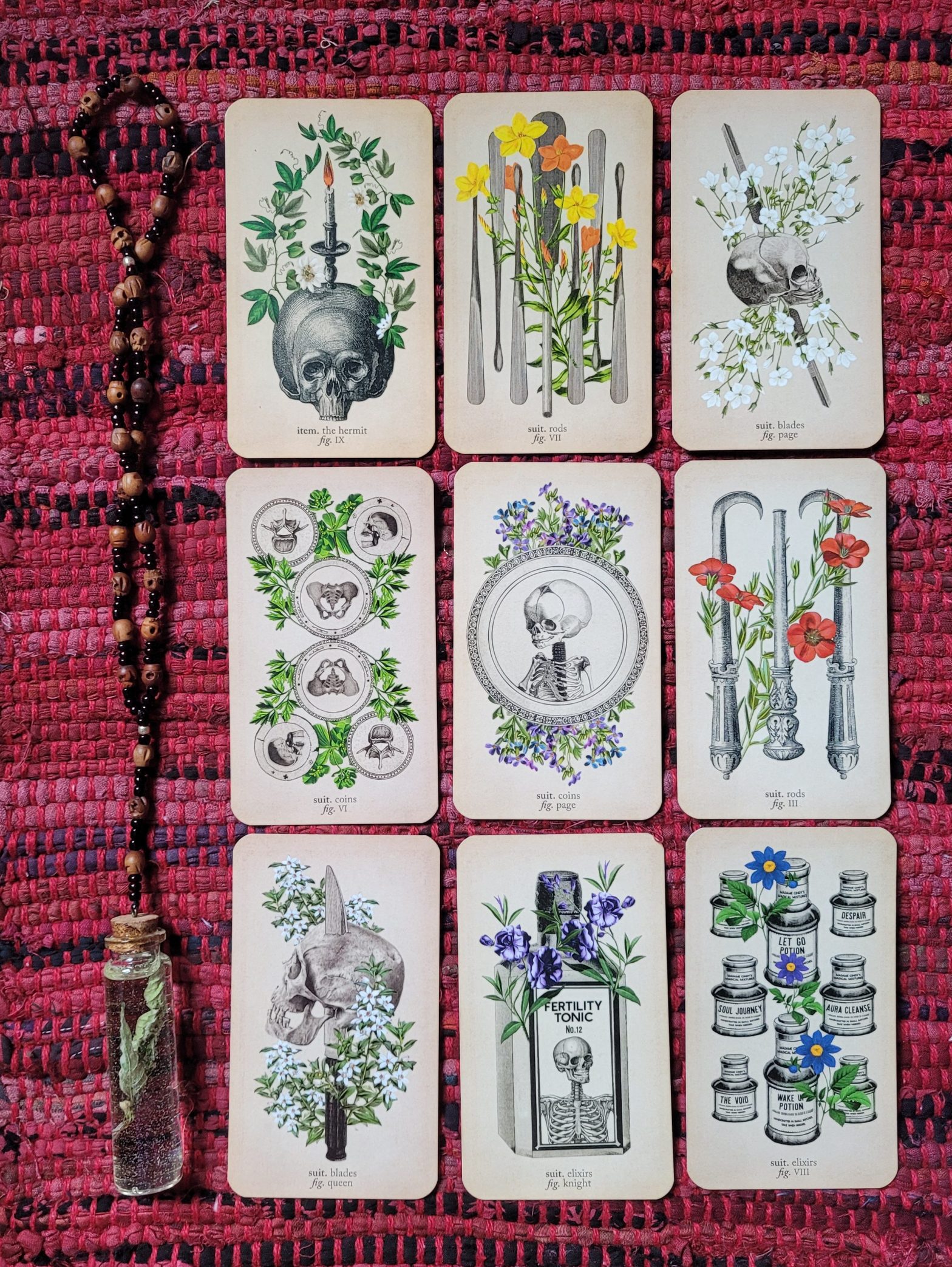
Pictured: Antique Anatomy Tarot by Black and the Moon

Radical suggestion one: There is no such thing as “the tarot.” By this, I mean we have today not one singular tarot tradition, but many traditions with quite stark differences between them. We know, of course, that tarot did not actually arise from ancient Egyptian priests or medieval qabalists. It is not the perfectly preserved treasure guarded over centuries by ancient mystical grandpas. The tarot deck was without question invented as a game in the 1400s, though it quickly found its way into folk magic and divination soon after, evolving over the centuries into the many branches of tarot tradition we see today, all of them distinct and equally valid.

The main streams of modern tarot are connected primarily with the types of decks we use, and these consist mainly of Marseille, Smith-Waite, Thoth, and Sola Busca (though encountering this last type of reader is sadly a rarity). Almost any tarot deck today can be described as a variant or an evolution of one or more of these basic traditions. Marseille readers tend to rely more on folk traditions (which are very diverse and can contradict one another) and pattern discernment, which is admittedly my own camp. Thoth readers lean on more complex ceremonial magical concepts as written about by Aleister Crowley and his contemporaries. Sola Busca readers draw on mythology and Greco-Roman historical characters in order to weave together their readings. Smith-Waite is, of course, the most influential reading style today, but we must remember that it is also relatively young, drawing on the systems invented around the early 1900s by an organization known as the Golden Dawn.

While all of these traditions are equally valid and capable of facilitating a rich reading, the young tarot reader might benefit from learning to recognize these camps and perhaps deciding which is their preferred path of study. An expert who claims, for instance, that the Hanged Man represents enlightenment is probably speaking from the perspective of either the Smith-Waite or Thoth school of thought. Similarly, one who asserts that the Hanged Man represents humiliation is more likely to be speaking as a Marseille reader. Both would agree that this card can imply a change in perspective. And Sola Busca might simply ask, “Hanged Man who?” Our various traditions and styles inform how we read and talk about the cards on a deep level, and a little self-reflexivity goes a long way in terms of understanding how our approach might differ from another reader’s. This is especially true, and I do hate to say it, of Smith-Waite readers, who sometimes assume that theirs is the only tarot tradition in existence.

Radical suggestion two: Correspondences are flawed. Now, hold on just a moment. Before anyone gets their feathers ruffled over this one, let me explain what I really mean. There’s nothing wrong with memorizing a few key facets of a particular card or even wondering how a card might express itself in another context (i.e., What kind of weather would the Hermit be? If the Star were a popular song on the radio, what might that song be?). This is learning by analogy, a tried and true approach to mastery in many disciplines. Where we get into trouble is when we begin dividing and categorizing obsessively in an effort to make everything “fit” inside its neat little box, to imagine a card for all things, and all things in their card. It is probably not helpful, for example, to decide that for all time, in every reading, the Empress shall correspond to Venus. Unless you are conducting purely astrological readings, this categorical approach only limits her potential for complexity in a spread, and it reduces the art of reading to mere translation.

We are better readers, I think, when we treat the cards like whole people, understanding what they desire and how they often express themselves, but also allowing for the fact that they may do something wild and unpredictable. We can allow ourselves to be surprised by the ways familiar cards turn up in a spread, and we can resist the urge to oversimplify their natures. Our Empress may, depending on our style of reading, bear Venusian qualities, but she is also a ruler, and regardless of our tarot tradition, she will often have something to do with power. While this power may be held in a gentler or more inward way than in the Emperor, that isn’t really saying much, is it? Her nature, like the nature of a living, breathing person, is complex and multifaceted. Reading tarot is not a perfectly ordered, meticulously enumerated science; it is an art, and it is messy. In a lovely way.

Radical suggestion three: It is the reader who divines, not the cards. This suggestion seems less radical on first glance. When we draw cards for a querent, it is tempting to fall into a routine of explaining their associations one by one in a linear fashion, as if we are simply reading a book, sentence by sentence and page by page. And yet, in this type of reading, we miss the story that is unfolding between and across the cards in the form of repetitions, reflections, contrasts, and progressions. These connections between cards offer the most insightful moments in a reading, and they are interpreted entirely by the individual reader. The cards do not offer an objective, linear statement of fact, but are symbols and patterns interpreted wholly through the skills of the reader.

It’s simply true that two different readers, when gazing at the same spread, might tell two different stories. Let us appreciate, though, that the querent has chosen their reader, and that in this choice, fate has placed a given reader before them for a reason. The querent relies on and trusts the reader’s skills of discernment. We are empowered by that sacred trust, in that moment, to do more than simply rattle off individual card associations. We are not only allowed, but obligated to trust our experience, ability, and intuition in the act of discernment, and this duty is what allows us to let go of doubt and reach boldly for insights that only we can offer the human being sitting before us.

Radical suggestion four: Memorization will not make us good readers. In the beginning, many types of card readers set the early goal of memorizing keywords and associations for each individual card. While it’s certainly necessary to have a sound working knowledge of the cards on an individual level, an overly simplistic process of memorization can easily become a trap that actually stifles our development. Suppose we do the thing and memorize a handful of keywords for each card. Eventually, a card is going to turn up in a position or in proximity to another card that just doesn’t jive with the cage we’ve constructed for it, leaving us scrambling for clues.

Instead of rote memorization in the manner of flash cards, I recommend learning groupings and pairings of cards together so that it becomes very natural to recognize patterns in an overall spread. What do the fives seem to have in common? The nines? The suits? What do cards beside each other in the trump (or major arcana) sequence have to do with one another? We might note, for example, that in the Tarot de Marseille there is a natural pairing structure built into the trumps so that each card is reflected in another (Sun and Moon, Empress and Emperor, Pope and Popess, Chariot and Hanged Man, etc.). What do these pairings suggest? Do they complement or antagonize one another? What changes when we move between them? What is different? What is the same?

Radical suggestion five: Guidance is more important than prediction. This one is a very common point of disagreement among readers, and I’ll note here that my views are usually in the minority when it comes to this. On the one hand, many readers claim that it is our chief task to predict events that have yet to occur so that the querent may prepare themselves. Assuming that the trajectories identified in a spread are fixed foretellings to begin with (which is another discussion entirely), I personally find that foreknowledge rarely leaves people more prepared for the event in question. The major events of our lives–joyful or painful–are not things the heart can truly prepare for in advance. And the mind seems even more capable of denial. On a macro level, consider our very culture that continues destroying the planet despite the known and inevitable disaster awaiting us, that refuses to prioritize a living wage despite the fact that most of us live a month’s salary away from hunger, and that mistreats the elderly, knowing good and well that each of us will (if we’re lucky) grow old and be counted among them.

Much like these widespread cultural refusals to act on foreknowledge, querents usually do not change their behavior to prepare for an event. Or if they do, it may not have the intended effect. We all know how fickle fate can be. Telling a client that they’re going to get that raise may result in them putting in less effort at work, thereby thwarting the happy ending promised by the reading. Telling them that marital conflicts are going to get worse may create anxiety and tension, leading to a self-fulfilling prophecy that may have been avoidable if we had approached the reading in another way.

No, despite what the querent says, they do not actually want prediction. What they want (or perhaps, more accurately, what they need) is guidance and actionable advice, something they can follow through on. For some clients, what is truly needed is a challenge, a question to ponder that will help them navigate their situation with as much grace as can be managed. If we are successful at this, they should come away with an assignment of sorts, or at the very least, an idea of where to direct their attention and energy. Often, we can base this direction on the restoration of balance in the spread. For example, when we observe too many forces pulling the client in different directions, it is probably more helpful to direct them to prioritize than to say, “You’re going to collapse from juggling too many work projects.” The best readings, I often find, are advisory rather than purely predictive, caring rather than calculating, human-centered rather than stuff-centered.

Radical suggestion six: There’s more than one reading in a spread. In a way, this builds on radical suggestion number three, but I want to offer something else here. Even in the hands of a single reader, a spread has more than one story to tell. When we first come to tarot reading, I think we sometimes imagine a clear and singular vision forming in the cards, but the more experienced we become, the more complicated the story before us appears. Often, I find divergences in a spread of cards, usually indicating options within options or paths within paths. Tarot readers worry about confusing the client by laying too much before them, and I share this worry sometimes, but if presented as conditional statements, these sibling readings within a single spread can actually be more helpful than offering a paradigm. (i.e., “If you take X path, consider Y carefully” or “When choosing between A and B, be sure to make C your top priority.”) I’m a fan of taking photos of a spread for contemplation later or sharing a quick sketch of the spread with a client virtually so that they can consider the ways progressions in the spread branch off in different directions. The risk of messiness and confusion is always there in a reading, but we don’t remove that prospect by ignoring the complexity before us. When we intentionally ignore tensions and conflicts in a spread, we are oversimplifying and reducing, removing options that are may be helpful to the querent, limiting their perspective in ways that it need not be limited. My preference is to embrace the mess. Life itself is a mess sometimes, after all.

Let’s come clean now: these suggestions seem radical, but they’re really not, are they? At the core of each lies the idea of letting go, of loosening our grip a little bit, of acknowledging limitations, of allowing intuition and compassion to take the reins, of accepting what is actually before us in a spread, however unruly it may feel, rather than attempting to beat the truth out of it with a stick. Our knowledge and experience of the tarot, in whatever vein we practice it, can only take us so far in the end. Where do we go from here? Maybe we don’t have to try so hard to be good readers. Maybe we can simply let go of those impulses and assumptions that make us bad ones.

On Craft and Art

The popular modern rhetoric of witchcraft refers to our calling as both a craft, a practical thing to be done through concrete steps, and a kind of spiritual art, guided by vision and inspiration. Think of the words we use to describe what we do: “the craft,” “the old craft,” “the magical arts,” “the occult arts.” These are more than evocative phrasings, for they appear in old grimoires and manuals from hundreds of years in the past. We are, all of us, guilty of perhaps overemphasizing the “craft” element of our calling, neglecting what makes witchcraft an art. And yet, most of us recognize that our work is more than a mere series of actions, that its culmination is more than the sum of its parts. After all, if it were so, merely speaking an incantation would produce the desired effect, which is, as we all know, the stuff of fantasy novels.

No, there is more to our craft than a series of actions, but defining that something is tricky. For many of us, acts of magical power are sensed out intuitively, which is why many folk and traditional witches begin their learning by working through old charms and operations, meeting a mixture of successes and failures, often without knowing why. We know instinctively when the work is potent; there is a tangible feeling of excitement and arousal of spirit when this is the case, and yet, that sensation resists definition, evading our attempts to identify the variable that results in our success. What we want is to replicate that effect at will, but without understanding its nature, we are simply casting darts at a board.

It is in witchcraft-as-art that we find this missing piece, and if we accept witchcraft as a spiritual art, we can now reckon with certain principles that aid us in our search for success. One of the things that good art does very often is render the familiar unfamiliar, to allow us to experience something mundane through new eyes and senses. Think of a portrait that captures a side of someone only the painter could convey. Think of a piece of music that conjures deep emotions in a way that feels new to us. It isn’t simply that good art replicates experiences familiar to us already; that’s just imitation. Good art presents the known and familiar to us as something strange and wonderful, allowing us to feel young and unjaded, wrapped up in the sensation of the moment for what feels like the first time.

Potency in witchcraft is like this. If the execution of the charm feels raw and immediate, it is usually good. If our words and actions feel strange to us, all the better. If we feel like a strange, new person in the process, even more so. This is part of why we see so many psychoactive plants like henbane, belladonna, wormwood, and even cannabis in the old grimoires, for it is not so different than the bohemian artist chasing their green fairy in bottles of absinthe. We seek a raw experience, an ecstatic experience, to feel fully both the need and the charm to answer its ache. In incantations, we seek to feel the texture and weight of the words themselves in our mouths, to feel their impact upon the invisible listener behind and within the candle’s glow. In crafting talismans, we seek to feel fully the shaping of the object in our hands and the sinking of the charm within it like ingredients kneaded into warm dough. We construct elaborate altars and surround ourselves with evocative aesthetics all to this effect, but ultimately, all of these tricks and trinkets cannot do the work for us. They’re just things, after all. A dancer’s power is not in the costume or the set, but in controlled and intentional movement, set alight by feeling. In the course of time, many of us find that simple charms conducted slowly and deliberately, with care and appreciation, are more potent than all the ritual garb and expensive candles in the world. This is why so many experienced witches shed their elaborate baubles after many years, finding that they simply no longer need them.

Conversely, art without the discipline of craft is like fire without fuel, feeling without form. While the experienced witch is certainly capable of accomplishing more with less, having grown to know and understand the nature of potency, it is only through the structured discipline of craft that we acquire this taste, like a cook who no longer needs measurements, but simply knows when the flavor is right. And like cooks, we come to our skills by following recipes, tasting as we go and savoring them fully along the way. Like a saucier, we must learn not only how to build a béchamel and a hollandaise, but to understand what they feel and look and taste like when done well, to appreciate how the components within them come together, what principles guide this act of creation. In folk and traditional witchcraft, we observe over time the principles of contagion and sympathy in our magics, these two concepts being the engine within so many charms, and we come to understand the nature of ecstasy, which brings us into communion with the otherworld and carries us to our hidden sabbat. Overlooking the pragmatic fundamentals of craft-as-process robs us of these and many other valuable lessons, leaving us full of fire and longing, but with little practical knowledge to muster achievement.

We also find that trying to complete the work with speed or efficiency strangles our efforts, as does following step-by-step instructions too slavishly. We cannot allow ourselves to view the ingredients or actions in a charm as mere procedure, mere commodity. What we’re really after is art. This is part of why many of us choose to grow or forage our own ingredients, assemble our own tools, and burn our own dried fumigations. We could buy these things if we wanted to, but would our work be the same? The raw and vibrant experience we are seeking is not fast work, but slow work: to sow and to harvest, to dwell within the charm as we work it, to soak in it, to perform it while appreciating its flavor fully, slowly, intentionally, to savor our awareness of it, not unlike the movements in a dance. The art is not simply in the end result of our magics, but in the process of the charm itself. We want its sensations to surprise and arrest us. We want to be shaken from our modern “time management” consciousness, to feel and perceive our craft like the first charmers who performed it in the ancient dark, sensing and longing our way through its gestures. In this way, witchcraft is, at its core, resistant to commodification, for its rewards can only ever be won slowly, and a potent charm can never feel cheap or tawdry.

Often, we ask ourselves the old question: are we witches because we perform witchcraft, or do we perform witchcraft because we are witches? In other words, is witchcraft, at its core, something we do, or is it something we simply are? Simple, reductive answers to this question miss the point. A sculptor would likely say that they became what they are through practice and discipline, that in practicing their art over many years, sculpting naturally became a part of who they are. We witches often come to the craft feeling “called” to it, frequently with a predisposition for its demands and an instinct for what “feels right,” but this alone is not enough. It is only in the course of practice that our craft becomes a part of us, that it slowly awakens something within us, sharpening our instincts and enabling us to achieve potency in our art with fewer bells and whistles. And so, it seems the answer to our question is actually both: we become witches by practicing witchcraft, and we continue in this act of becoming, this ongoing awakening, through discipline. We are much like the sculptor, both doing and being as we try to understand what our art is and means, relying upon the discipline and structure of good, sound craft to guide us in our work along the way.

On Lineage, Tradition, and Folk

One of the questions I receive frequently is why I and others choose to identify the craft we love and practice as folk witchcraft rather than either Wicca or traditional witchcraft. The intention behind the question is almost always innocent, and the short answer is this: folk witches do not do or believe all of the things Wiccans do, and though folk craft is often discussed as a branch of “traditional” craft, it does not necessarily adopt the modern frameworks or ritual approaches designed by Robert Cochrane, Cora and Victor Anderson, or Andrew Chumbley, who represent the three most popular branches of traditional craft today. Unfortunately, sometimes the popularity of a given tradition results in a kind of enforced assimilation of magics, irrespective of the local or ancestral folk traditions of the practitioner (i.e., “If you don’t celebrate Ostara, you aren’t engaging with the whole Wheel of the Year,” or “If you’re not laying a compass or treading the mill, you aren’t practicing ‘old craft.'”). This erasure of diversity in older forms of craft is problematic for many reasons, not the least of which being its utter disregard for historical accuracy.

And yet, this question of where folk craft “fits” is more complex than it first appears. Folk witches do have more in common with Wiccans and traditional witches than not because the rituals we inherit and devise are often drawn from the same sources of wisdom that influenced Gardner, Cochrane, and others. Though I usually prefer to think of myself simply as another witch and leave the discussion of movements and categories to others, this question of distinction, if approached respectfully, can be a rich one that challenges us to recognize the many unique currents operating under the umbrella of modern witchcraft as a whole. By positioning ourselves within the broad and diverse landscape of witchcraft movements, we can better understand our differences, not as schisms or conflicts of ideology, but as a diversity of thought and approach that should be celebrated within the larger discourse of modern craft. All of these traditions are beautiful and unique, and recognizing our differences need not be governed by the same old boring and elitist question of who is more “authentic.”

In terms of ritual construction, folk craft is diverse and flexible. Traditional witches working in the Cochrane current perform the laying of the compass, the houzle or red meal, and the treading of the mill, all rituals designed in the mid-twentieth century by Robert Cochrane in his Clan of Tubal Cain. Andrew Chumbley’s tradition of what is now called sabbatic witchcraft, another branch of traditional witchcraft, is beautiful in intellectual and ritual approach, drawing on witch-lore and historic charms, but is also quite academic in nature, building upon Chumbley’s work in oneiric occultism as outlined in his books and essays. Folk witches may share some practices with these traditions, but ultimately, we prefer to draw our rituals and practices more directly from folk charms, grimoiric texts, and local and ancestral lore (often meaning one’s spiritual ancestors, not necessarily genetic ones, mind you; defining one’s “belonging” to a culture along purely genetic lines is the stuff of racism). Our construction of sacred space may adapt magic circles from old grimoires or simple “saining” traditions in folk magic. Offerings similar to the red meal are frequent, but these approaches are drawn directly from lore-born and ancestral folk customs for propitiating spirits: the offering of smoke, of cider or wassail, of milk and bread left out for the faeries, and of adaptations of eucharistic rites that echo folk-religious fusions.

On the question of cosmology and ethics, folk craft offers no unified answers. While Wicca offers a version of reincarnation, a summerland, and a three-fold law of return, folk craft is too diverse in its spiritual cosmologies to reduce to one definition. The cultures of our ancestors, along with our own experiences and explorations, determine how we view the world and the rules of operating within it. Most frequently, there is a recognition of the “other world” into which the witch may cross to interact with spirits and ancestors, but this world is wild and dark and usually defies efforts to map its geography or rules in human terms. Individual folk witches operate based on relationships with spirits, particularly familiar spirits, establishing boundaries and rules of personal operation based on experience during these sojourns. Folk craft is decidedly animist in its recognition of animal, plant, and local spirits as important partners. Baneful magic is perfectly valid, but is usually regarded with care for its impact.

In the Feri tradition founded by Cora and Victor Anderson, there are a multitude of defined witch-gods with which the practitioner may commune and consult. In folk craft grounded in the lore of Western Europe and North America, there is usually a recognition of the Devil as a teacher and guide based on his prominence in old witch lore. Also present is a female figure who may be Brigid or Mary, depending on the witch. The Faery Queen and King, who so frequently arise in Celtic lore, may also be invoked to attend rites. These figures coalesce into a syncretic dark king and queen in my own practice, but for other folk witches, these figures may be distinct in the manner of polytheism or may be less important. A folk witch with Slavic ancestry, for instance, may feel more comfortable calling upon Baba Yaga, and this is well and good, for those ties will strengthen that connection and ground the witch’s practice in something old and personal.

Although the terms “folkloric craft” and “folk magic” have become popular in recent years to describe branches of craft that draw heavily and directly from lore, they carry different connotations that are worth exploring. On the one hand, we have folk magic, which describes the actual, historic charms and superstitions worked by practitioners who may or may not identify as witches. On the other, we have folkloric craft, which devises rituals based on stories about witches in myth and lore, often more ornate than simple folk charms, and usually more focused on recreating visionary experiences based on mythic narratives. Folk craft encompasses both of these things. By blending historic folk charms that were practiced by ancestors with inspired wisdom from witch narratives in folklore, practitioners balance witchcraft as a practice and a personal spirituality, keeping what is good and old while breathing life into the ancient tales that continue to teach us today.

Perhaps most distinctly, folk witches, unlike practitioners continuing in the traditions of Gardner, Cochrane, Chumbley, or the Andersons, usually prefer to practice our craft alone or in very small groups instead of in a modern coven. Part of this is practical, since it allows us to focus more on our individual ancestries, locales, and spirit-led traditions, but part of it is also historical. Hundreds of years ago, folk craft practitioners worked alone or perhaps with one or two others. This is as true in the case of the cunning folk and fairy doctors as it is in the case of pow-wows, herb doctors, pellars, and other charmers. There was no fixed curriculum of magical instruction for these sorcerers of old, but they were aware of ancestral and local charms and customs and, if they were lucky, owned at least one grimoire, such as the Grimorium Verum, The Magus, The Sixth and Seventh Books of Solomon, or The Grand Grimoire, drawing from the sigils and incantations therein to enrich their art. Through experimentation, they developed their own styles and approaches to craft. Their solitary practice was not a weakness, but a strength, allowing them to focus on a particular area of the charming arts, mastering it to the level of infamy, such as highland seers who focused on finding lost people and objects or Cornish pellars who tended to healing and warding. Rather than empowering practitioners to root more deeply into their own cultures and folk traditions, most magical orders and schools from the late 1800s on have functioned as places to forget these treasures, to become assimilated into a one-size-fits-all curriculum that rewards conformity over diversity, paradigms over cultural flavors and their variations. Perhaps this is part of why our kin operating in the rich and potent currents of brujeria, stregoneria, and rootwork avoid these spaces. For folk witches, a more rigorous curriculum is to be found in studying the old folklore, superstitions, and herbal wisdom, in perusing treasures at a local flea market, in getting to know the wild herbs that grow on our own land, and in self-reflexive contemplation on where we come from, how we got here, and what our traditions mean. While “folk” has in the past held the connotation of “poor,” it would be a mistake to imagine that these treasures leave us wanting, for they are deeply nourishing.

And yet, despite all of these differences, folk witches have strong ties to practitioners of Wicca and to practitioners within sister veins of traditional craft. The lore preserved in Aradia, which became so foundational to Gardner’s vision of Wicca, is also important to many folk witches (though we might also read some of Leland’s other folkloric volumes, which are equally stunning). The use of the forked staff or stang, popularized by Cochrane, is prized by folk witches for its presence in The Grand Grimoire as a “blasting rod” and in the lore of the distaff and forked branch in superstition. The sigil techniques recommended by Chumbley are also employed by folk witches to decipher the names and natures of familiar spirits and to empower all manner of charm, modeled after the many seals and sigils recorded in the grimoiric traditions beloved by both movements. In truth, our traditions, distinct as they may be, are nourished by the same sources of lore and spiritual revelation, and for these reasons and many others, we witches of our various tribes are and always will be kin.