Three pieces currently in development, for use in a forthcoming work…
Three pieces currently in development, for use in a forthcoming work…
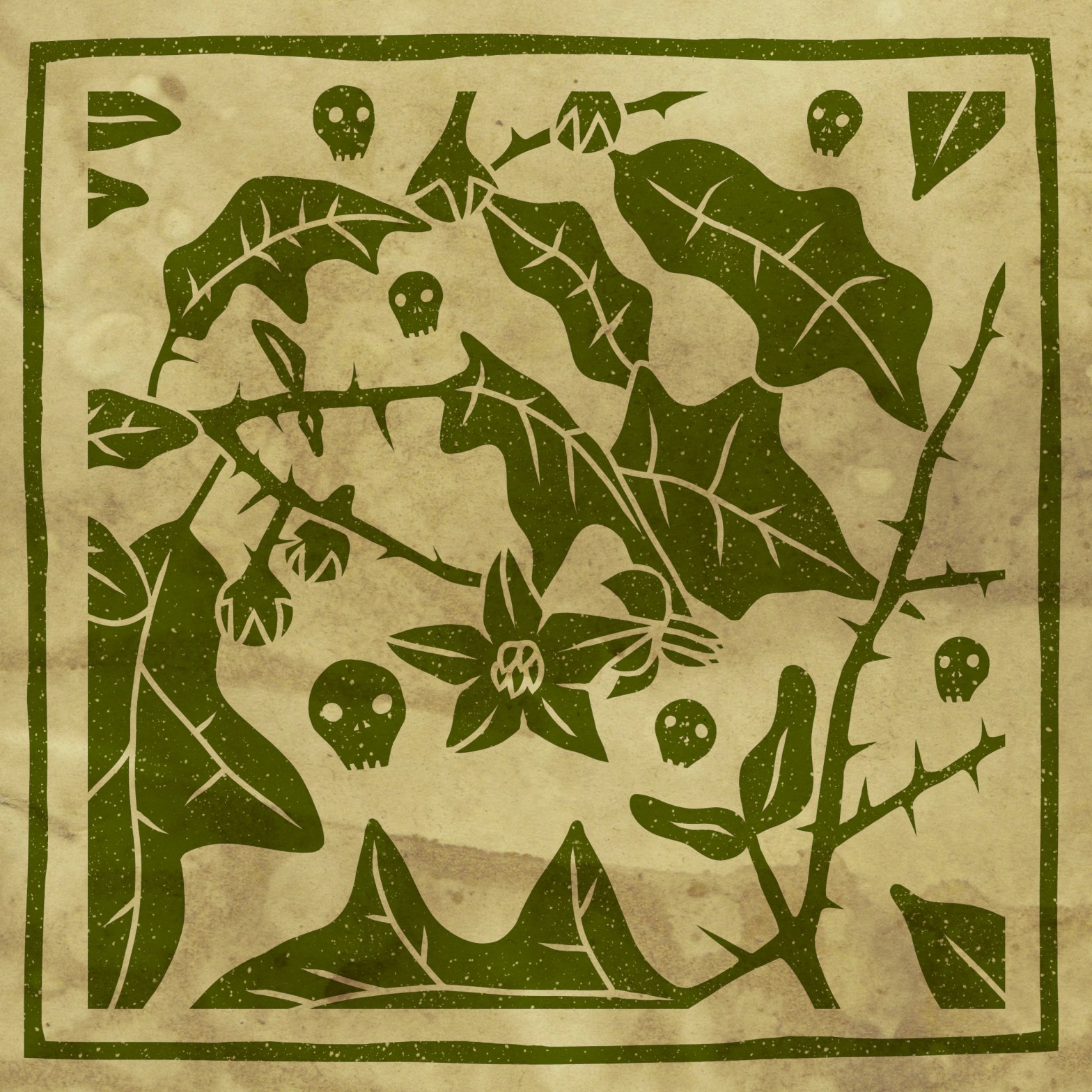

Here is a thorn among the green,
Sharp and tender as a tooth.
Here are five songs for the dead,
Five movements, five gestures,
Five dances for that dark company
In five ballrooms, every one as lush
As these woods in the long exhale
At the end of summer. The grasses
Yellow, and the flower in the throng
Of barbed horse nettle sharpens
Its bone-white blades, pale as haunting,
Against the grit of forest floor. What
Does the ghost of the poison flower
Dream as she withers around her globe
Of fruit, clutching her green pearl,
Her waxing prize, even as her petals
Dry to husk? Not even the blackbirds
Can conjure the music she hears,
The sixth song, the one no creature
Of flesh can sing, fragile as we are.

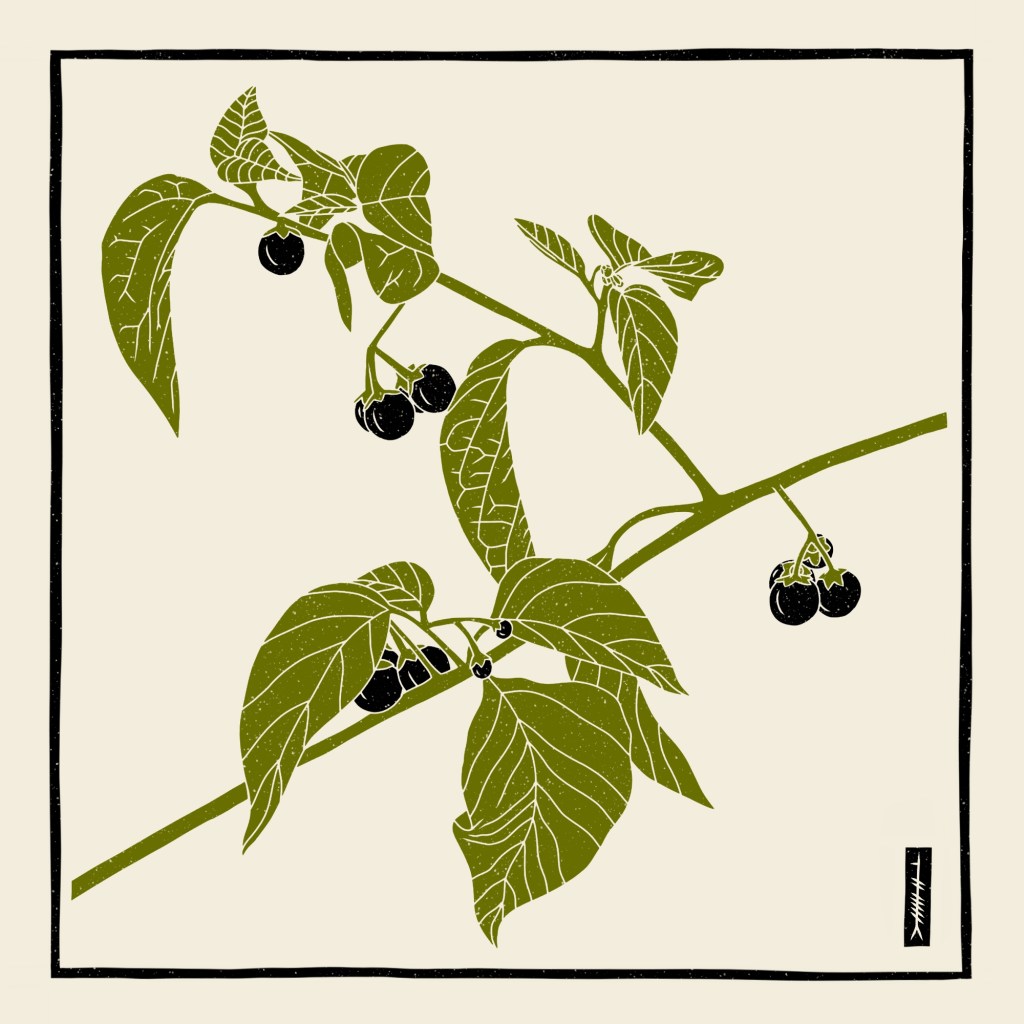
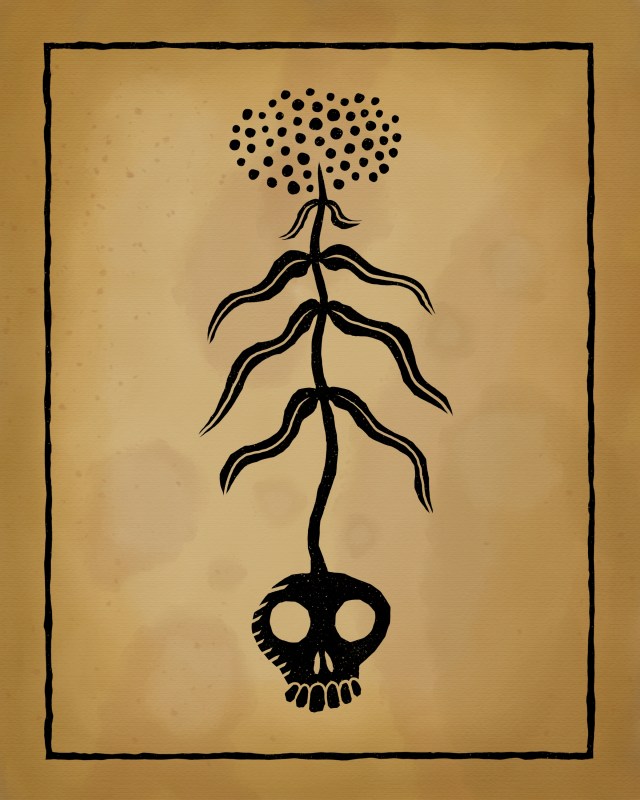
“Black nightshade is sometimes confusingly referred to as ‘deadly nightshade’ in older herbals due to its fruit, which does somewhat resemble the berries of the belladonna plant. Its flowers are quite distinct, though, being small and very delicate blooms of white and yellow. The American variety (solanum ptychanthum) has glossy berries, while the berries of the solanum nigrum are typically more matte in appearance. Most varieties of black nightshade contain levels of the toxin solanine that are quite dangerous to the body…”
-from The Charmer’s Root: Witching Ways with Common Flora
Original illustration based on a plant found in the wild.
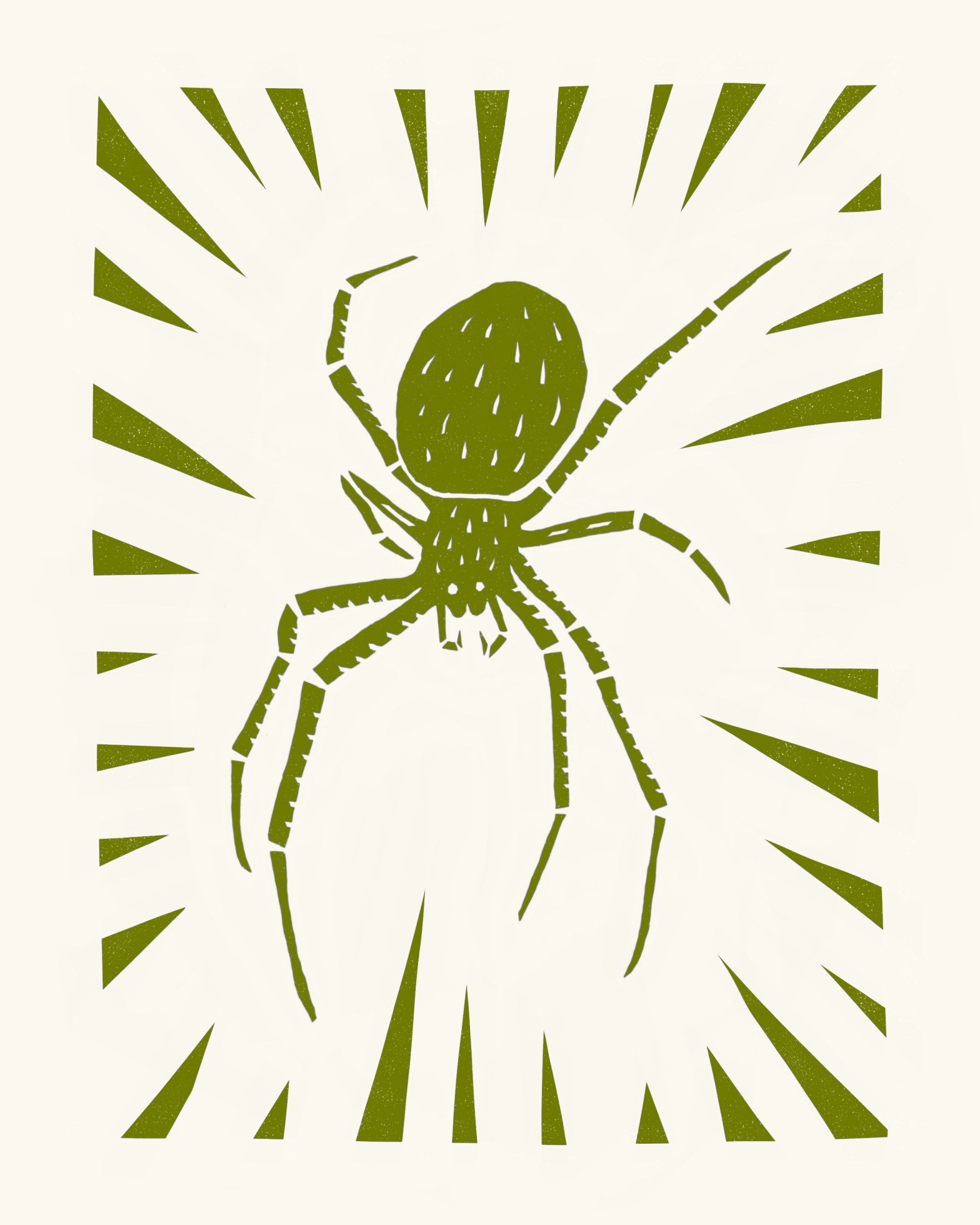
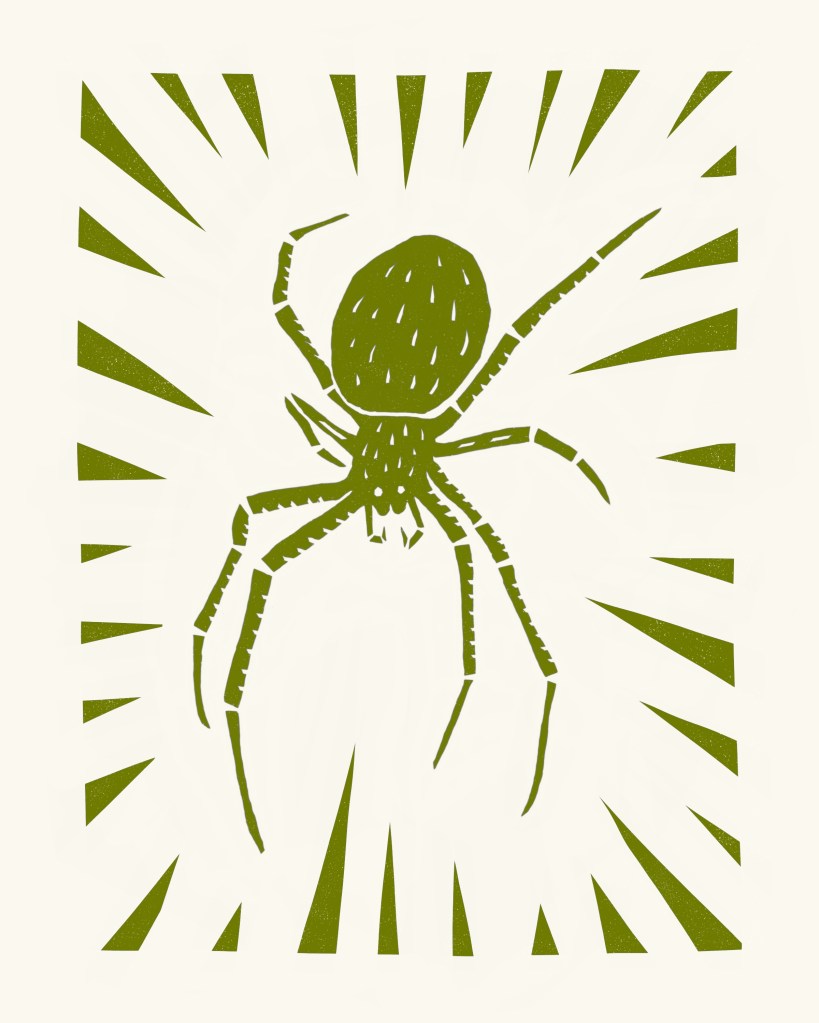
“If you wish to live and thrive, let a spider run alive.”

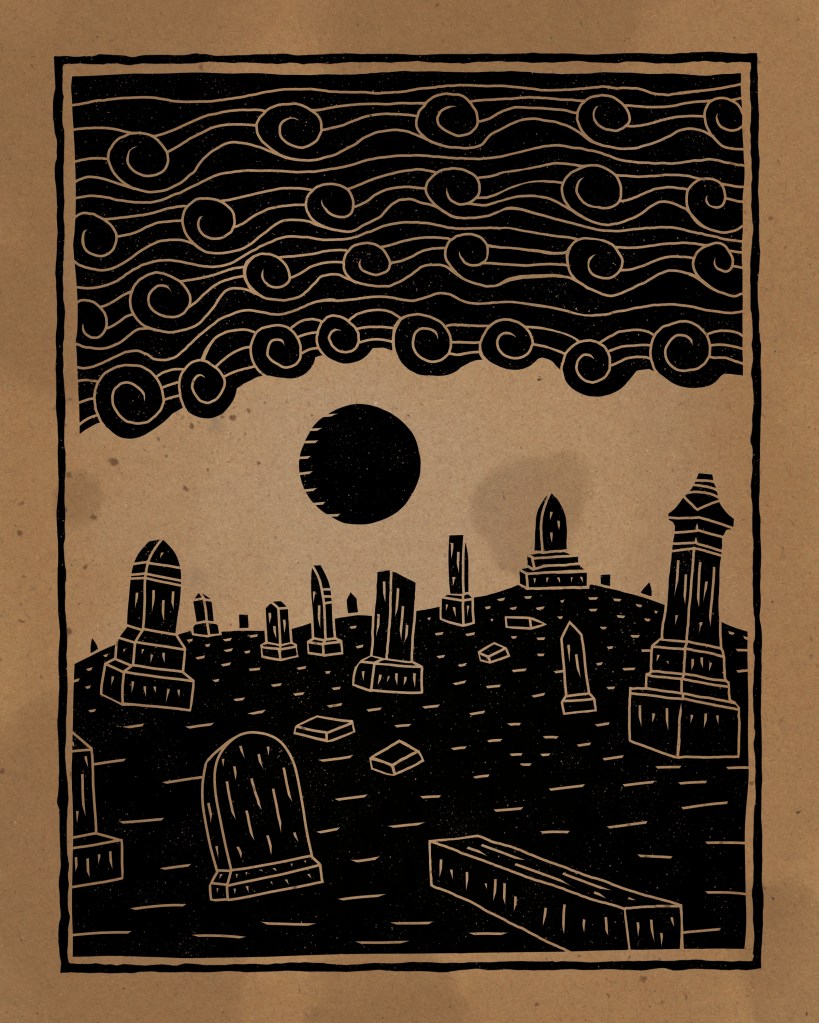
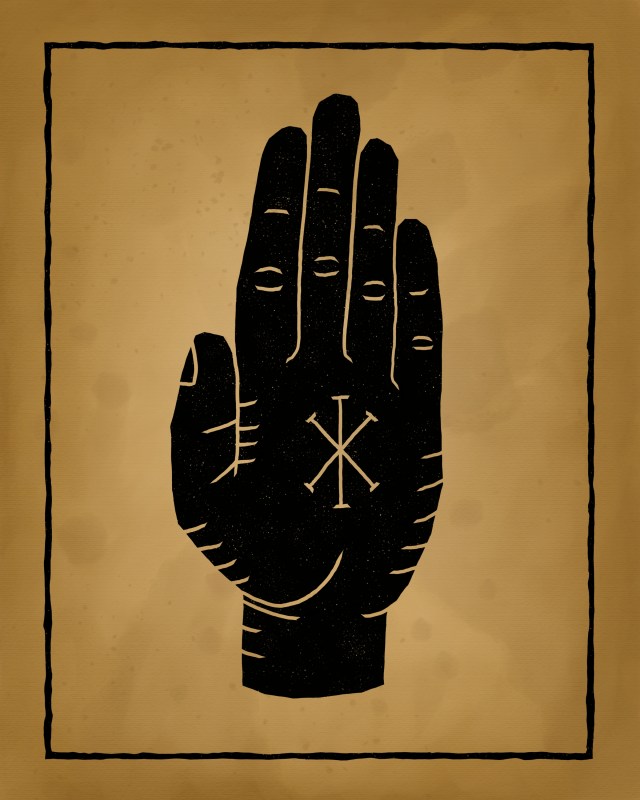
Woodcut-style illustration on an aged paper background. Available on prints, greeting cards, and more at https://rjstudio.threadless.com/designs/hillside-graves.
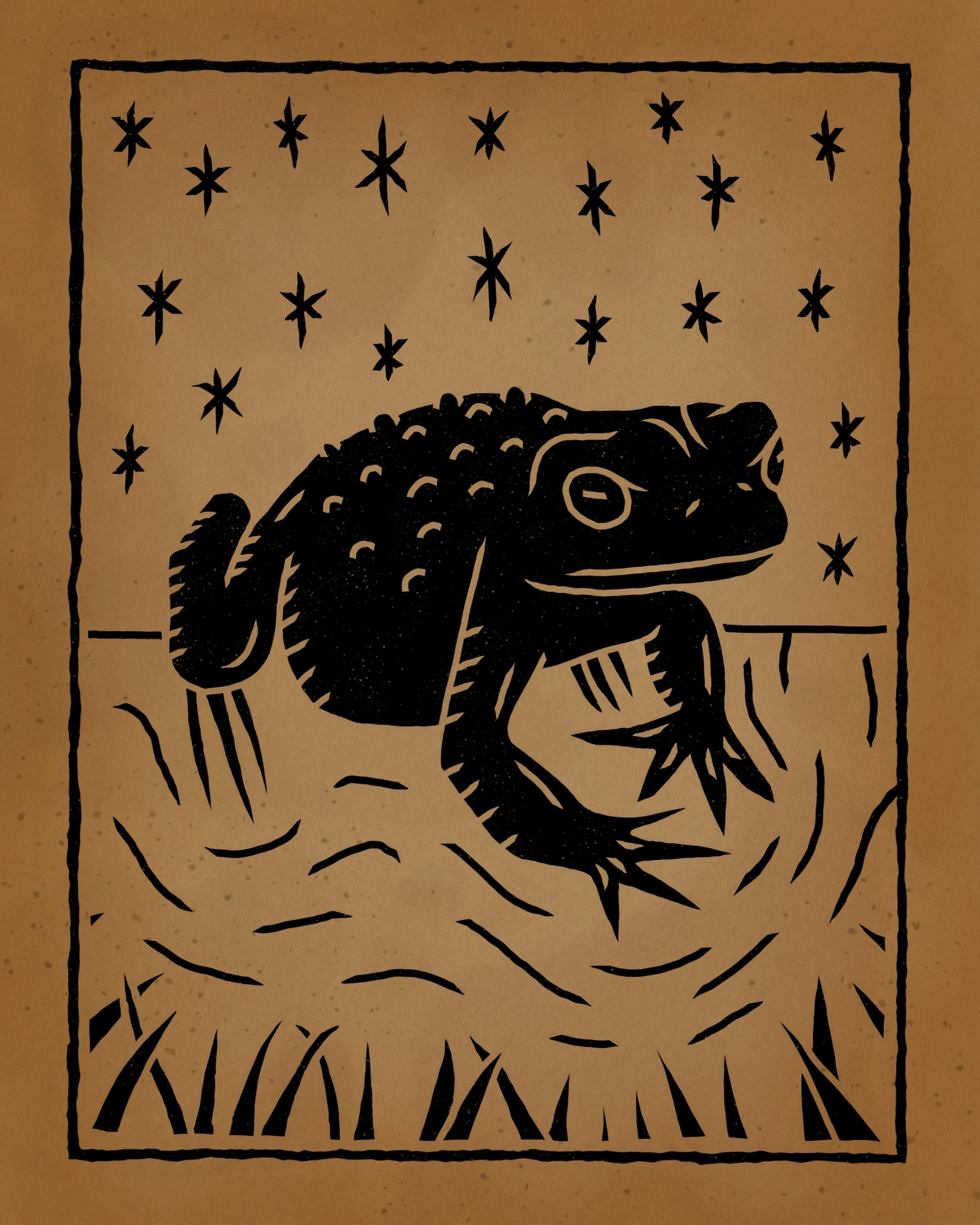
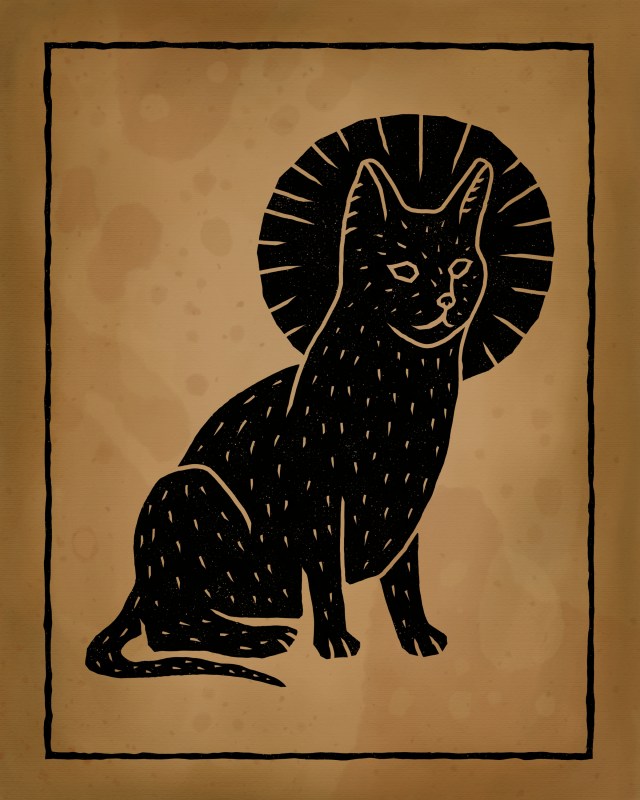
Woodcut-style illustration on an aged paper background. Available on prints, greeting cards, t-shirts, and more at https://rjstudio.threadless.com/designs/starry-toad/prints.

As many of you know, I’ve been in love with woodcuts for the longest time, which prompted me to take a printmaking class years ago. After developing my own process of woodcut-style illustration for the Age of Witchery Tarot, I’ve decided to take another leap and reinstate my old Threadless-powered art shop with some new work. These pieces are now available for purchase in the form of fine art prints, greeting cards, tees, and pins. Visit the shop here.
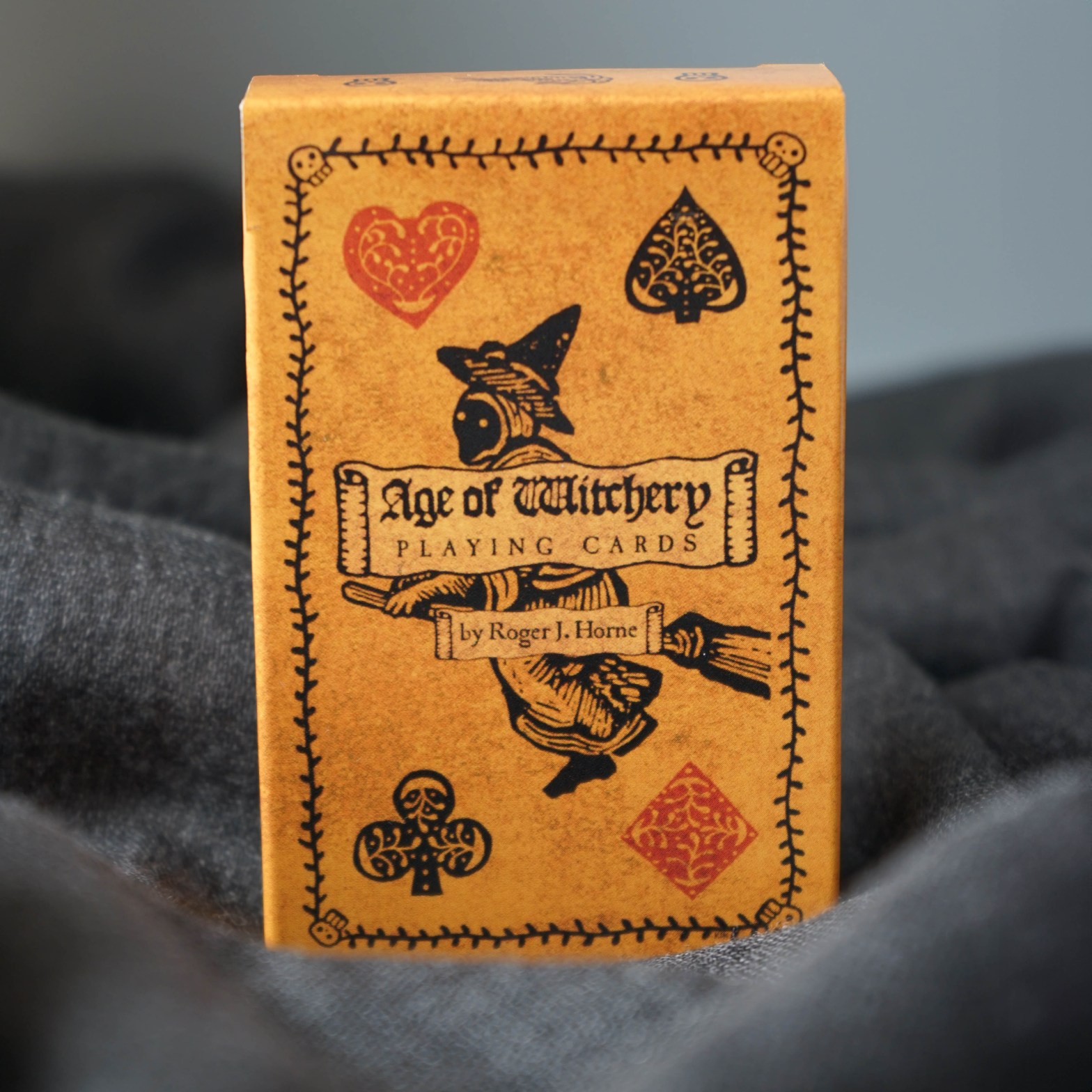
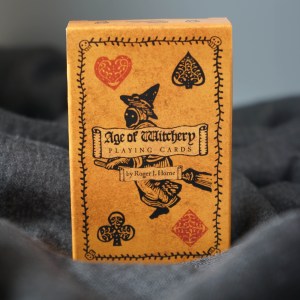
When I set out to create the Age of Witchery Tarot Deck, I of course knew that there would also be a playing card iteration of this project. Playing cards are, for many, a more earthy, flexible tool for divination. Playing cards offer simple patterns of suit and number and dual coloration of red and white instead of the complex imagery of the trump sequence. Like tarot, readers rely on the oscillations of symbols in order to form meanings, but unlike tarot, the playing card deck feels somehow humble, down to earth, and deeply practical as opposed to lofty and philosophical.
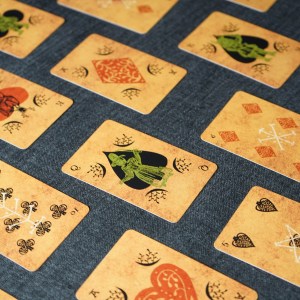
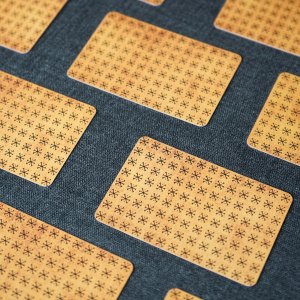
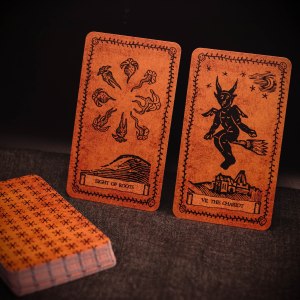
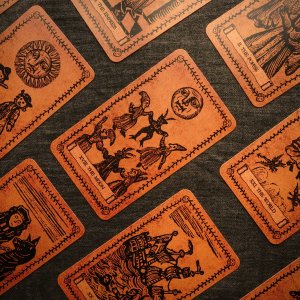
Like the Age of Witchery Tarot, the Age of Witchery Playing Card Deck draws on adapted woodcuts from the 1700s alongside my own illustration work. I ultimately decided to create a bridge sized deck (2.25 inches by 3.5 inches), which is slightly narrower than poker sized cards (2.5 inches by 3.5 inches). I like this size simply because you can fit more cards comfortably on a smaller surface. I chose to maintain the black and red coloration, but with the addition of green in the black court cards or face cards, creating more visual contrast for the sake of the reader, who is often scouring a spread for patterns and reflections between cards. While I wanted to maintain the weathered, antiqued background of the Age of Witchery Tarot, this needed to be lighter and brighter on such small cards for ease of readability, resulting in an amber color that is similar, but different from the rust or leather color on its sister deck. Like its sister, this deck of cards comes with a link to a digital guide, including a bit of history, interpretations, and spreads.
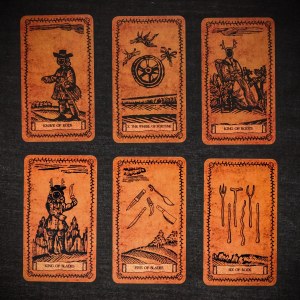
The two distinct features of this deck that will stand out most to cartomancers are its reversibility and the inclusion of numeric glyphs. Each card is designed so that it is truly asymmetrical, meaning that one can tell if the card is upright or reversed. Many of us, of course, choose not to read reversals, but I wanted this deck to at least offer the choice rather than ignore the question entirely. The numeric glyphs that appear on the number cards are unobtrusive, but clear visual cues derived from both the number of the card (usually translated into a number of lines) as well as the subtle symbolism of basic geometric configurations and their relation to witchcraft. The benefit here is that one can, of course, simply read the number on the card, but with such small cards, one might also rely on quickly recognizing these geometric forms by candlelight, a cross signaling four, a line signaling two, a tree signaling ten, and so on.
This may sound like a simple thing, but I’m particularly proud of the suit symbols as they appear on the minor cards. This was one of the most difficult choices because I did not want to substantially change them, but I wanted to breathe into them the same aesthetic and flavor of the Age of Witchery Tarot. They are each designed in the style of woodcuts, featuring delicate cut-outs of vines and moons. The cards are printed, of course, and not pressed with wooden blocks coated with ink as they would have been hundreds of years ago, but designing in this style gives the cards a feel of something older than themselves, connecting the deck, which is admittedly modern, to older designs and methods that came before, like part of a living tradition.
For now, the Age of Witchery Playing Card Deck, like its sister tarot deck, is available via PrinterStudio, which also offers bulk order discounts so that retailers may profit from sales.
May your cards be ever sharp. Order your deck here.

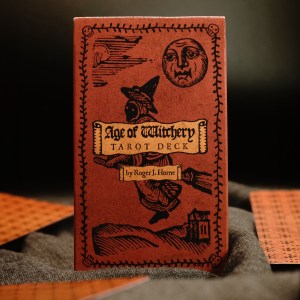
For most of my life, I’ve dreamed of designing a tarot deck. Tarot and cartomancy were, for me, some of my first entry points into the craft I practice now, and divination remains the core of my practice, not merely as a way to gain insight into complex situations, but as a form of contemplation, ritual, magic, spirit communication, and sacred play. Tarot is a language both individual and shared, arising out of symbols evolved over centuries, but wielded with the skill of the practitioner. Working with the cards helps us to understand our own deep needs and desires, which is perhaps the greatest power we can hope to wield in a world that is ever telling us what we should want and who we should be. The spread of the cards before us is like a deep, dark pool into which we gaze, interpreting the ripples along the surface, knowing that beneath lies our connection to the parts of ourselves that are hidden and the spirits that surround us–both light and dark.
The Age of Witchery Tarot has, in truth, been years in the making. For a very long time, I toyed with illustrations and concepts, filling entire sketchbooks with ideas, but I kept returning to the old woodcuts of the 1700s, the age that bore much of the witch-lore that informs folk practitioners today. These were brutal times for certain, shaped by the fear and loathing of so many things–of women, of surviving pagan customs, of Catholicism, of sexuality, of learning, of spirits, of magic. And yet, within the age-worn images of that time, we see what truly lies at the core of society’s fear of witches: the fear of resistance, the fear of empowerment, and ultimately, the fear of ourselves, the fear that something within our nature is dark and wild, that it cannot be contained by any church or institution, that each of us, perhaps especially the poorest and most marginalized, possesses some hidden power. And although they did not resemble the monstrous creatures witch-hunters imagined, we know of course that there were (and still are) folk charmers, herb doctors, seers, and cunning folk who wielded their magic and divination in previous ages, some of these being my own ancestors, and very likely yours as well, dear reader. Look closely at the superstitions, signs, and folk charms observed in your own family, and you may well find that a bit of the old witchery survives in you. The name of this deck is a play on this thought–for as we modern practitioners know, the age of witchery is not dead or gone; it is now.
The process of assembling these images was painstaking at times, but also delightful. The elements drawn from 1700s woodcuts are largely collaged together, since no existing composition adequately captured the pieces necessary to form the scenes we know from the Marseille tarot tradition. A single card often required drawing from as many as five or six woodcuts in order to create the necessary details. These collaged compositions had to be edited and embellished with my own illustration work–replacing linework that was unclear or damaged, placing objects into hands, finishing part of an image that was missing or cut off, redrawing facial expressions with something more appropriate to the card, repositioning arms and legs so that the postures of two figures did not look too similar, shrinking or enlarging elements so that they appear to belong in the same scene, and of course, incorporating my own decorative border work. The absence of colored inks did not make this job much easier–if anything, color helps the eye to discern one object from another, and in its absence, I had to work hard to keep the images simple and recognizable so that the eye could easily make out what was happening in each scene. I ultimately chose to preserve simplicity in the minor or pip cards, allowing individual practitioners to choose whether to read them in line with numerology, astrology, the prescribed modern meanings assigned by Waite, or any other system of choice.
I’m proud of the culmination of this long effort, and I’m excited to see how other witches, pagans, and tarot enthusiasts make use of this deck. For now, the Age of Witchery Tarot is available to purchase via PrinterStudio, which offers bulk discounts for retailers so that they may also benefit from sales. If the distribution channels change, I’ll be sure to update all links on my website so that the deck can be easily found.
May your cards be ever sharp, witches. Purchase the deck here.


 Roger J. Horne