
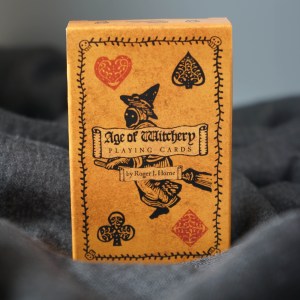
When I set out to create the Age of Witchery Tarot Deck, I of course knew that there would also be a playing card iteration of this project. Playing cards are, for many, a more earthy, flexible tool for divination. Playing cards offer simple patterns of suit and number and dual coloration of red and white instead of the complex imagery of the trump sequence. Like tarot, readers rely on the oscillations of symbols in order to form meanings, but unlike tarot, the playing card deck feels somehow humble, down to earth, and deeply practical as opposed to lofty and philosophical.
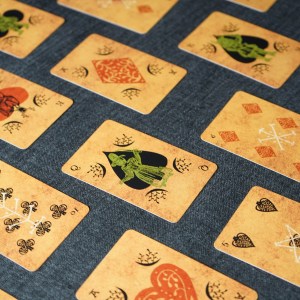
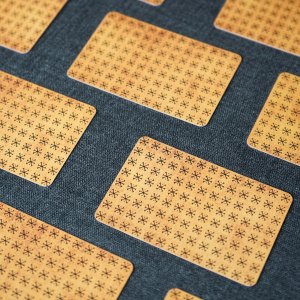
Like the Age of Witchery Tarot, the Age of Witchery Playing Card Deck draws on adapted woodcuts from the 1700s alongside my own illustration work. I ultimately decided to create a bridge sized deck (2.25 inches by 3.5 inches), which is slightly narrower than poker sized cards (2.5 inches by 3.5 inches). I like this size simply because you can fit more cards comfortably on a smaller surface. I chose to maintain the black and red coloration, but with the addition of green in the black court cards or face cards, creating more visual contrast for the sake of the reader, who is often scouring a spread for patterns and reflections between cards. While I wanted to maintain the weathered, antiqued background of the Age of Witchery Tarot, this needed to be lighter and brighter on such small cards for ease of readability, resulting in an amber color that is similar, but different from the rust or leather color on its sister deck. Like its sister, this deck of cards comes with a link to a digital guide, including a bit of history, interpretations, and spreads.
The two distinct features of this deck that will stand out most to cartomancers are its reversibility and the inclusion of numeric glyphs. Each card is designed so that it is truly asymmetrical, meaning that one can tell if the card is upright or reversed. Many of us, of course, choose not to read reversals, but I wanted this deck to at least offer the choice rather than ignore the question entirely. The numeric glyphs that appear on the number cards are unobtrusive, but clear visual cues derived from both the number of the card (usually translated into a number of lines) as well as the subtle symbolism of basic geometric configurations and their relation to witchcraft. The benefit here is that one can, of course, simply read the number on the card, but with such small cards, one might also rely on quickly recognizing these geometric forms by candlelight, a cross signaling four, a line signaling two, a tree signaling ten, and so on.
This may sound like a simple thing, but I’m particularly proud of the suit symbols as they appear on the minor cards. This was one of the most difficult choices because I did not want to substantially change them, but I wanted to breathe into them the same aesthetic and flavor of the Age of Witchery Tarot. They are each designed in the style of woodcuts, featuring delicate cut-outs of vines and moons. The cards are printed, of course, and not pressed with wooden blocks coated with ink as they would have been hundreds of years ago, but designing in this style gives the cards a feel of something older than themselves, connecting the deck, which is admittedly modern, to older designs and methods that came before, like part of a living tradition.
For now, the Age of Witchery Playing Card Deck, like its sister tarot deck, is available via PrinterStudio, which also offers bulk order discounts so that retailers may profit from sales.
May your cards be ever sharp. Order your deck here.
 Roger J. Horne