
Let’s just say it, shall we? Cartomancers disagree on how to read the court cards. Attend a tarot workshop with one reader, and you’ll be trained in one method. Read a book by another, and you’ll encounter a completely different system for understanding these characters. I’d like to unpack a few different approaches here in broad terms, but not in order to place any value system upon them. On the contrary, what I’d like to say is really this: that each approach to addressing court cards has its own strengths and weaknesses, and it is the intuition and style of the reader that will determine which method is most appropriate. In knowing ourselves, we will come to know what the best method of reading is for us; this is true in many ways, and it is certainly true of approaching the royal families of Fate’s wheel.
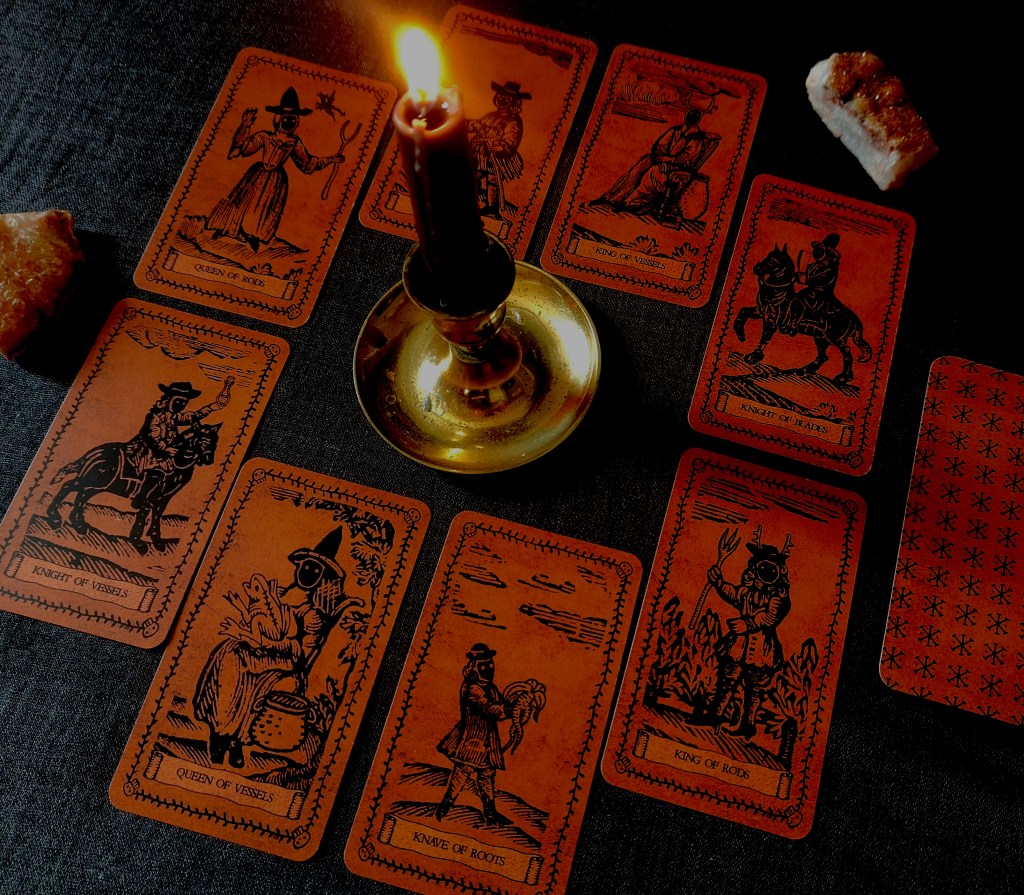
One of the oldest methods that doesn’t enjoy as much use today is to interpret the court cards as persons in the querent’s life who have certain physical characteristics. In this system, Queens are women, Kings are men, Knights are youths (of any gender), and Pages or Knaves are children (again, of any gender). The suit is often used in this style of reading to determine other physical characteristics in a variety of ways. Coins might indicate dark features, while Rods indicate red hair, for example. Sadly, this system leaves out gender queer or non-binary adults, and the problems we run into when associating cards with ethnic attributes also become clear rather quickly. It’s estimated that anywhere from 80-90% of people in the world have brown or black hair, and yet only one or two of the suits are devoted to this quality? Instead, readers who subscribe to this method might use the suit to indicate a person’s size, height, or physical mannerisms in some way. What we really should not do here is read physical characteristics and personalities as correspondences, for having blonde hair doesn’t make a person adventurous (or any other thing) by nature. The benefit of this method is that we are able to describe a person quite physically, but the drawback is that we have less information regarding their inner qualities. This problem can be mitigated, though, by reading the cards surrounding the court card for more information.
This brings us to the most popular method today for interpreting the court cards: as people in the querent’s life with certain archetypal or astrological personalities. Instead of associating a particular card with a person’s bodily presence, we are reading it entirely as a set of non-physical qualities. The Queen of Coins might be anyone who in a querent’s life who is possessed of a very nurturing quality, regardless of gender. The Page of Cups might be any person who is highly in touch with their inner child and sense of wonder, regardless of their physical age. This approach is helpful because it focuses on how the querent perceives the people in their life and their relationship to them, and it emphasizes the gifts (or, alternatively, burdens) they have to share with the querent. Problematically, this system can also describe people the querent hasn’t noticed, or it may be describing a person they know quite well using qualities that make sense, but don’t immediately “click.” The querent might say, “Oh, hmmm, I guess that description really does fit John better than Sarah.” Still, the time spent trying to pinpoint the court card’s identity in the querent’s life can be a bit frustrating, distracting from other, more important topics.
Finally, we come to my two favorite methods, both of which completely abandon the idea of court cards as external persons. I think both of these methods have grown more popular in recent years. The first of these posits that court cards do not represent people in a querent’s life, but rather, represent spiritual influences along a particular stretch of their journey. For example, the appearance of the Knight of Rods might be guiding the querent to be more bold and assertive in matters of their career or creative projects. Likewise, the Page of Swords might be offering the suggestion to be more adaptable in the face of a current struggle. These are not people, or even aspects of people, but are read as spiritual guides who answer the call of the spread and decide to offer their wisdom in the moment of the reading. The benefit of this reading style is that we can cut to the heart of the matter rather quickly, avoiding the game of “who’s who” and dealing instead with the more crucial question of what is to be done next at the current crossroads of their life.
Lastly, my very favorite. (I’m more than a little biased, of course.) This method reads the court cards as aspects of the querent’s own self, however hidden, underutilized, or unfulfilled. If, for example, we meet with the King of Cups in the releasing position of a three-card spread, we might interpret that the time to draw on our inner philosopher is not now. This is, perhaps, a time to let go of worrying about inspiring others or influencing them with our grand ideologies, and instead to focus on something else. If we meet with the Queen of Rods in the central position, we might interpret that we are, in the present moment, called to rely on our social skills, our charm, and our ability to navigate power structures. This is different from the previous method in that the presence of these cards here indicates that the querent already possesses these gifts, or is in the process of acquiring them. These presences are not external spirits or guides showing up in the cards, but are in fact powers alive within the querent themselves, often as a seed waiting to be realized. In fairness to the other methods described above, I must point out the downside of this approach: that our reading, in focusing entirely on the querent’s sphere of influence, can be misinterpreted to suggest that they have the power to reshape any circumstance in their life, which isn’t true. The querent cannot simply will their way out of poverty, disease, or a broken heart. On the other hand, we cannot leave a querent feeling entirely powerless, for that is also a lie. The querent always has some power, however small (or, more often, only seemingly small). My chosen focus, as a reader, is on empowering the querent with choice and self-knowledge, even if those choices are limited, because dwelling on things outside of our control–well–it just isn’t very useful, is it?
Ultimately, it isn’t really necessary to dedicate oneself to one of the methods above. Readers often synthesize more than one system, which is as it should be. But it is important, I think, to conduct a self-inventory from time to time, to reflect on how we tend to read the court cards and why we find ourselves drawn to that approach. If, in reflecting on this question, we aren’t really sure, then perhaps that is an opportunity to experiment with a different method. After all, it is in the experience of giving readings that we find what works well for us and what does not.
 Roger J. Horne