I’m not a disruptive sort of person. I try hard to respect others’ perspectives, to foster harmony, and to assume a good reason behind things I don’t yet understand. Still, there are times for making bold statements out loud, not to incite conflict, but to challenge widespread assumptions and paradigms that become passively ingrained in our practices, and in that spirit, I’d like to offer up a series of radical suggestions that a new tarot reader might consider when it comes to taking up the cards.
Radical suggestion one: There is no such thing as “the tarot.” By this, I mean we have today not one singular tarot tradition, but many traditions with quite stark differences between them. We know, of course, that tarot did not actually arise from ancient Egyptian priests or medieval qabalists. It is not the perfectly preserved treasure guarded over centuries by ancient mystical grandpas. The tarot deck was without question invented as a game in the 1400s, though it quickly found its way into folk magic and divination soon after, evolving over the centuries into the many branches of tarot tradition we see today, all of them distinct and equally valid.
The main streams of modern tarot are connected primarily with the types of decks we use, and these consist mainly of Marseille, Smith-Waite, Thoth, and Sola Busca (though encountering this last type of reader is sadly a rarity). Almost any tarot deck today can be described as a variant or an evolution of one or more of these basic traditions. Marseille readers tend to rely more on folk traditions (which are very diverse and can contradict one another) and pattern discernment, which is admittedly my own camp. Thoth readers lean on more complex ceremonial magical concepts as written about by Aleister Crowley and his contemporaries. Sola Busca readers draw on mythology and Greco-Roman historical characters in order to weave together their readings. Smith-Waite is, of course, the most influential reading style today, but we must remember that it is also relatively young, drawing on the systems invented around the early 1900s by an organization known as the Golden Dawn.
While all of these traditions are equally valid and capable of facilitating a rich reading, the young tarot reader might benefit from learning to recognize these camps and perhaps deciding which is their preferred path of study. An expert who claims, for instance, that the Hanged Man represents enlightenment is probably speaking from the perspective of either the Smith-Waite or Thoth school of thought. Similarly, one who asserts that the Hanged Man represents humiliation is more likely to be speaking as a Marseille reader. Both would agree that this card can imply a change in perspective. And Sola Busca might simply ask, “Hanged Man who?” Our various traditions and styles inform how we read and talk about the cards on a deep level, and a little self-reflexivity goes a long way in terms of understanding how our approach might differ from another reader’s. This is especially true, and I do hate to say it, of Smith-Waite readers, who sometimes assume that theirs is the only tarot tradition in existence.
Radical suggestion two: Correspondences are flawed. Now, hold on just a moment. Before anyone gets their feathers ruffled over this one, let me explain what I really mean. There’s nothing wrong with memorizing a few key facets of a particular card or even wondering how a card might express itself in another context (i.e., What kind of weather would the Hermit be? If the Star were a popular song on the radio, what might that song be?). This is learning by analogy, a tried and true approach to mastery in many disciplines. Where we get into trouble is when we begin dividing and categorizing obsessively in an effort to make everything “fit” inside its neat little box, to imagine a card for all things, and all things in their card. It is probably not helpful, for example, to decide that for all time, in every reading, the Empress shall correspond to Venus. Unless you are conducting purely astrological readings, this categorical approach only limits her potential for complexity in a spread, and it reduces the art of reading to mere translation.
We are better readers, I think, when we treat the cards like whole people, understanding what they desire and how they often express themselves, but also allowing for the fact that they may do something wild and unpredictable. We can allow ourselves to be surprised by the ways familiar cards turn up in a spread, and we can resist the urge to oversimplify their natures. Our Empress may, depending on our style of reading, bear Venusian qualities, but she is also a ruler, and regardless of our tarot tradition, she will often have something to do with power. While this power may be held in a gentler or more inward way than in the Emperor, that isn’t really saying much, is it? Her nature, like the nature of a living, breathing person, is complex and multifaceted. Reading tarot is not a perfectly ordered, meticulously enumerated science; it is an art, and it is messy. In a lovely way.
Radical suggestion three: It is the reader who divines, not the cards. This suggestion seems less radical on first glance. When we draw cards for a querent, it is tempting to fall into a routine of explaining their associations one by one in a linear fashion, as if we are simply reading a book, sentence by sentence and page by page. And yet, in this type of reading, we miss the story that is unfolding between and across the cards in the form of repetitions, reflections, contrasts, and progressions. These connections between cards offer the most insightful moments in a reading, and they are interpreted entirely by the individual reader. The cards do not offer an objective, linear statement of fact, but are symbols and patterns interpreted wholly through the skills of the reader.
It’s simply true that two different readers, when gazing at the same spread, might tell two different stories. Let us appreciate, though, that the querent has chosen their reader, and that in this choice, fate has placed a given reader before them for a reason. The querent relies on and trusts the reader’s skills of discernment. We are empowered by that sacred trust, in that moment, to do more than simply rattle off individual card associations. We are not only allowed, but obligated to trust our experience, ability, and intuition in the act of discernment, and this duty is what allows us to let go of doubt and reach boldly for insights that only we can offer the human being sitting before us.
Radical suggestion four: Memorization will not make us good readers. In the beginning, many types of card readers set the early goal of memorizing keywords and associations for each individual card. While it’s certainly necessary to have a sound working knowledge of the cards on an individual level, an overly simplistic process of memorization can easily become a trap that actually stifles our development. Suppose we do the thing and memorize a handful of keywords for each card. Eventually, a card is going to turn up in a position or in proximity to another card that just doesn’t jive with the cage we’ve constructed for it, leaving us scrambling for clues.
Instead of rote memorization in the manner of flash cards, I recommend learning groupings and pairings of cards together so that it becomes very natural to recognize patterns in an overall spread. What do the fives seem to have in common? The nines? The suits? What do cards beside each other in the trump (or major arcana) sequence have to do with one another? We might note, for example, that in the Tarot de Marseille there is a natural pairing structure built into the trumps so that each card is reflected in another (Sun and Moon, Empress and Emperor, Pope and Popess, Chariot and Hanged Man, etc.). What do these pairings suggest? Do they complement or antagonize one another? What changes when we move between them? What is different? What is the same?
Radical suggestion five: Guidance is more important than prediction. This one is a very common point of disagreement among readers, and I’ll note here that my views are usually in the minority when it comes to this. On the one hand, many readers claim that it is our chief task to predict events that have yet to occur so that the querent may prepare themselves. Assuming that the trajectories identified in a spread are fixed foretellings to begin with (which is another discussion entirely), I personally find that foreknowledge rarely leaves people more prepared for the event in question. The major events of our lives–joyful or painful–are not things the heart can truly prepare for in advance. And the mind seems even more capable of denial. On a macro level, consider our very culture that continues destroying the planet despite the known and inevitable disaster awaiting us, that refuses to prioritize a living wage despite the fact that most of us live a month’s salary away from hunger, and that mistreats the elderly, knowing good and well that each of us will (if we’re lucky) grow old and be counted among them.
Much like these widespread cultural refusals to act on foreknowledge, querents usually do not change their behavior to prepare for an event. Or if they do, it may not have the intended effect. We all know how fickle fate can be. Telling a client that they’re going to get that raise may result in them putting in less effort at work, thereby thwarting the happy ending promised by the reading. Telling them that marital conflicts are going to get worse may create anxiety and tension, leading to a self-fulfilling prophecy that may have been avoidable if we had approached the reading in another way.
No, despite what the querent says, they do not actually want prediction. What they want (or perhaps, more accurately, what they need) is guidance and actionable advice, something they can follow through on. For some clients, what is truly needed is a challenge, a question to ponder that will help them navigate their situation with as much grace as can be managed. If we are successful at this, they should come away with an assignment of sorts, or at the very least, an idea of where to direct their attention and energy. Often, we can base this direction on the restoration of balance in the spread. For example, when we observe too many forces pulling the client in different directions, it is probably more helpful to direct them to prioritize than to say, “You’re going to collapse from juggling too many work projects.” The best readings, I often find, are advisory rather than purely predictive, caring rather than calculating, human-centered rather than stuff-centered.
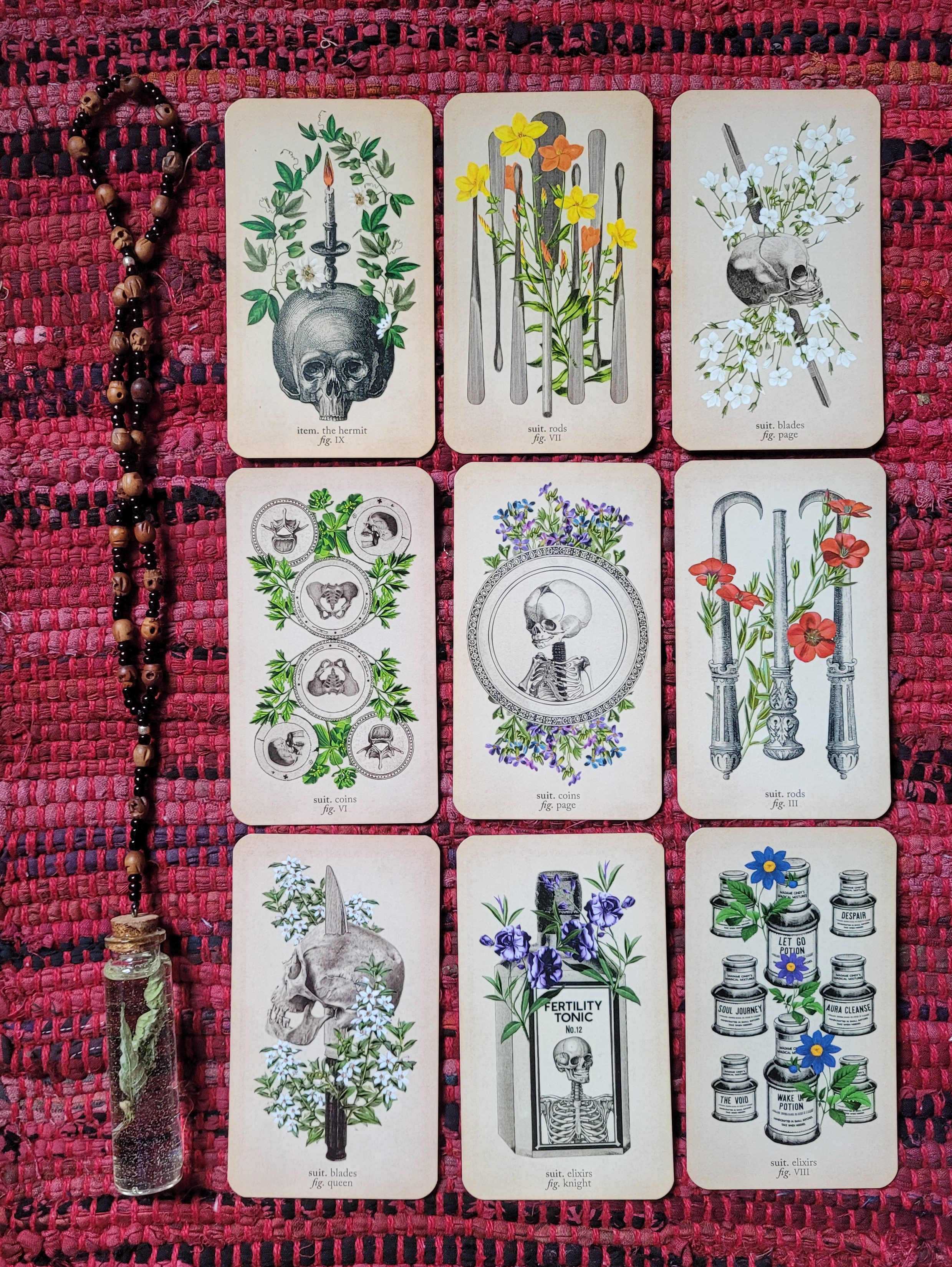
Radical suggestion six: There’s more than one reading in a spread. In a way, this builds on radical suggestion number three, but I want to offer something else here. Even in the hands of a single reader, a spread has more than one story to tell. When we first come to tarot reading, I think we sometimes imagine a clear and singular vision forming in the cards, but the more experienced we become, the more complicated the story before us appears. Often, I find divergences in a spread of cards, usually indicating options within options or paths within paths. Tarot readers worry about confusing the client by laying too much before them, and I share this worry sometimes, but if presented as conditional statements, these sibling readings within a single spread can actually be more helpful than offering a paradigm. (i.e., “If you take X path, consider Y carefully” or “When choosing between A and B, be sure to make C your top priority.”) I’m a fan of taking photos of a spread for contemplation later or sharing a quick sketch of the spread with a client virtually so that they can consider the ways progressions in the spread branch off in different directions. The risk of messiness and confusion is always there in a reading, but we don’t remove that prospect by ignoring the complexity before us. When we intentionally ignore tensions and conflicts in a spread, we are oversimplifying and reducing, removing options that are may be helpful to the querent, limiting their perspective in ways that it need not be limited. My preference is to embrace the mess. Life itself is a mess sometimes, after all.
Let’s come clean now: these suggestions seem radical, but they’re really not, are they? At the core of each lies the idea of letting go, of loosening our grip a little bit, of acknowledging limitations, of allowing intuition and compassion to take the reins, of accepting what is actually before us in a spread, however unruly it may feel, rather than attempting to beat the truth out of it with a stick. Our knowledge and experience of the tarot, in whatever vein we practice it, can only take us so far in the end. Where do we go from here? Maybe we don’t have to try so hard to be good readers. Maybe we can simply let go of those impulses and assumptions that make us bad ones.
 Roger J. Horne